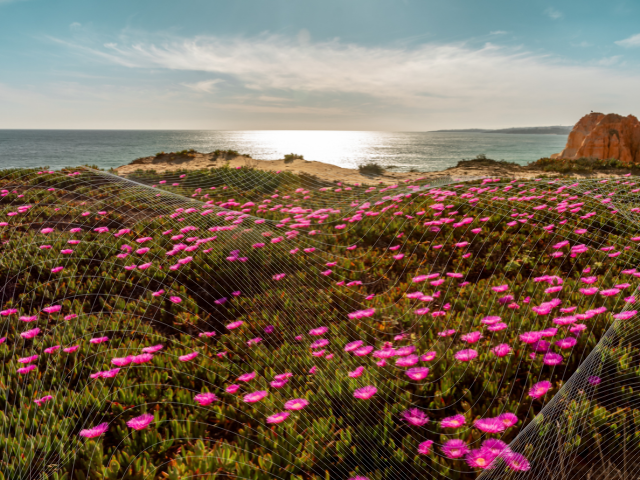
California Native Wildflowers Utilizing and synthesizing data from nearly 200 published articles, NCEAS researchers examined the effects of various environmental stressors on plant growth and decomposition, two crucial processes in any ecosystem. They measured the rate of species loss in different ecosystems, and found that where there was greater plant species loss, there was an increased negative impact on plant growth and an alteration in decomposition. The effects of biodiversity loss on biomass were similar to the effects from other environmental stressors, including global warming, pollution, and acid rain.

A global synthesis reveals biodiversity loss as a major driver of ecosystem change
David U. Hooper, E. Carol Adair, Bradley J. Cardinale, Jarrett E. K. Byrnes, Bruce A. Hungate, Kristin L. Matulich, Andrew Gonzalez, J. Emmett Duffy, Lars Gamfeldt and Mary I. O’Connor
Nature, 11118, May 2, 2012 (online)

UCSB press release

Following is a sample of the media coverage of this study:
National Science Foundation: Ecosystem effects of biodiversity loss rival climate change and pollution
Scientific American: How biodiversity keeps earth alive
CORDIS News: (Europe) Biodiversity loss a major threat to plant growth, researchers warn
Earth Times: Biodiversity loss from species extinctions may rival pollution and climate change impacts
Futurity: Extinction's toll could rival climate change
The News Tribune: WWU biologist: Loss of plant biodiversity could affect ecosystems as much as global climate change, pollution
The Seattle Times: WWU biologist: Plant diversity key to ecosystem
Statesman Journal: Ecology: WWU biologist says plant diversity key to ecosystem
UPI: Study: Biodiversity loss hits environment

More information about this project's research, participants and publications

Researchers collecting data from a new climate change experiment near Boston. An NCEAS working group found that experiments may dramatically underestimate how plants will respond to climate change in the future. Their findings, published in Nature, indicate that shifts in the timing of flowering and leafing in plants due to global warming appear to be much greater than estimated by warming experiments. As a result, species could change far more quickly than such studies suggest, possibly affecting water supplies, pollination of crops and ecosystems.

Warming experiments underpredict plant phenological responses to climate change
E. M. Wolkovich, B. I. Cook, J. M. Allen, T. M. Crimmins, J. L. Betancourt, S. E. Travers, S. Pau, J. Regetz, T. J. Davies, N. J. B. Kraft, T. R. Ault, K. Bolmgren, S. J. Mazer, G. J. McCabe, B. J. McGill, C. Parmesan, N. Salamin, M. D. Schwartz and E. E. Cleland
Nature, 11014, May 2, 2012 (online)

UCSB press release
UCSD press release

Following is a sample of the media coverage of this study:
BBC News: Plants flower faster than climate change models predict
Greenwire: Experiments underestimate plants' response to warming -- study
NASA: Decades of data show spring advancing faster than experiments suggest
Reuters: Plant study flags dangers of warming world
Science: Plant experiments underestimate climate change effects
USA Today: Study: Climate change causes plants to flower earlier

Related data sets:

More information about this project's research, participants and publications

Oil containment boom surrounds New Harbor IslandUpon the second anniversary of the Deepwater Horizon blowout in the Gulf of Mexico, a national panel of researchers offers a new model for understanding what happened in this disaster, how to think of such events in the future, and why existing tools were inadequate to fully predict what lay before them. The findings of the NCEAS' "Ecotoxicology of the gulf oil spill: A holistic framework for assessing impacts" working group are published in the May issue of BioScience.

A Tale of Two Spills: Novel Science and Policy Implications of an Emerging New Oil Spill Model
Charles H. Peterson, Sean S. Anderson, Gary N. Cherr, Richard F. Ambrose, Shelly Anghera, Steven Bay, Michael Blum, Robert Condon, Thomas A. Dean, Monty Graham, Michael Guzy, Stephanie Hampton, Samantha Joye, John Lambrinos, Bruce Mate, Douglas Meffert, Sean P. Powers, Ponisseril Somasundaran, Robert B. Spies, Caz M. Taylor, Ronald Tjeerdema, and E. Eric Adams
BioScience, 62(5), 461-469, 2012

UCSB press release
NSF press release

Following is a sample of the media coverage of this study:
Ventura County Star: CI Professor leads panel on Deepwater Horizon oil spill

More information about this project's research, participants and publications

 Frasier fir killed by the balsam woolly adelgid NCEAS researchers report in Frontiers in Ecology and the Environment that almost 70 percent of the most damaging non-native forest insects and diseases currently afflicting U.S. forests arrive via imported live plants. Once introduced, some of these imported insects and disease organisms establish, and a fraction become major economic pests. The authors describe several possible means to increase bio-security, including intensified efforts at plant inspection stations, precautionary measures that restrict plants from entering the U.S. until risks have been assessed, expanding post-entry quarantines, developing better advance knowledge about pest insects and pathogens, and developing integrated systems approaches that depend on expanded partnerships between researchers and industry.

Live plant imports: the major pathway for forest insect and pathogen invasions of the US
Andrew M. Liebhold, Eckehard G. Brockerhoff, Lynn J. Garrett, Jennifer L. Parke, and Kerry O. Britton
Frontiers in Ecology and the Environment, 10(3), 135-143, 2012

UCSB press release

The following is a sample of the media coverage of this study:
New York Times, Green Blog:Who Knows What Bugs Lurk in Imported Plants?

More information about this project's research, participants and publications

Big Horned Sheep, Glacier National Park, Montana, USA A new study published in Landscape Ecology evaluates the ways that spatial uncertainty, landscape characteristics, and genetic stochasticity interact to influence the strength and variability of conclusions about landscape-genetics relationships.

'Learning from the Octopus' Book Cover"Learning From the Octopus: How Secrets from Nature Can Help Us Fight Terrorist Attacks, Natural Disasters and Disease" explores security challenges we face, and shows us how we might learn to respond more effectively to the unknown threats lurking in our future. The main premise of the book is that natural organisms have learned to thrive in an unpredictable and risk filled planet without having the power to plan, predict, or try to perfect themselves.

Learning From the Octopus: How Secrets from Nature Can Help Us Fight Terrorist Attacks,
Natural Disasters and Disease

By Rafe Sagarin
Published by Basic Books, A Member of the Perseus Books Group
2012

Following is a sample of the media coverage of this study:
AAAS News: Ecologist Rafe Sagarin: Applying Nature's Lessons to Modern Security Challenges
Book excerpt in The Week:  What we can learn from the Octopus
Huffington Post:  10 Lessons You Can Learn from Nature (PHOTOS)
Scientific American:  What Can an Octopus Teach Us About National Security? A Q&A with Ecologist Rafe Sagarin
Slate:  How Smart is the Octopus?
Stanford Magazine:  Tide Pools & Terrorists
Wired:  When Catastrophe Strikes, Emulate the Octopus

More information about this project's research , participants and publications

NCEAS, DataONE, and LTER logos We are pleased to announce a training workshop “Software Tools for Sensor Networks” sponsored by NCEAS, LTER, and DataONE. The training workshop will be held May 1 - May 4, 2012 at the LTER Network Office in Albuquerque, NM. We have support to cover travel and lodging for participants that need it. Registration is now open with a deadline of March 25, 2012. Please see http://sensor-workshop.ecoinformatics.org/ to register. Your participation will be confirmed by April 2, 2012. Participants will be selected to broadly represent the ecological and environmental science community. A draft agenda and resources are currently listed on the webpage and will be more fully detailed in the coming weeks.

photo of Gaviota PeakGraduate programs have placed an increasing emphasis on the importance of interdisciplinary education, but barriers to interdisciplinary training still remain. This article, published in BioScience, summarizes the lessons learned from a highly successful implementation of NCEAS' distributed graduate seminar in the new field of landscape genetics.

Developing an Interdisciplinary, Distributed Graduate Course for Twenty-First Century Scientists
H.H. Wagner, M.A. Murphy, R. Holderegger, L. Waits
BioScience, 62(2):182-188, Feb 2012

More information about this Distributed Graduate Seminar

African Ape Infectious disease has recently joined poaching and habitat loss as a major threat to African apes. A study published in PLoS ONE explores both the risk of disease to African apes, and the status of potential interventions.

Consequences of Non-Intervention for Infectious Disease in African Great Apes
Sadie J. Ryan and Peter D. Walsh
PLoS ONE, 6(12): e29030, 2011

UCSB press release

Following is a sample of the media coverage of this study:
Futurity: To battle disease, apes may need vaccines

More information about this project's research, participants and publications

Gian jellyfish clogging fishing nets in Japan A new study published in BioScience questions claims that jellyfish are increasing worldwide, and suggests that such claims currently are not supported with any hard evidence or scientific analyses to date. Increased speculation and discrepancies about current and future jellyfish blooms by the media and in climate and science reports formed the motivation for this Working Group to convene at NCEAS to examine available data. Over 30 researchers have contributed to this research, assembling globally distributed jellyfish data to examine global jellyfish trends for the first time.

Questioning the rise of gelatinous zooplankton in the world's oceans
Robert H. Condon, William M. Graham, Carlos M. Duarte, Kylie A. Pitt, Cathy H. Lucas, Steven H.D. Haddock, Kelly R. Sutherland, Kelly L. Robinson, Michael N Dawson, Mary Beth Decker, Claudia E. Mills, Jennifer E. Purcell, Alenka Malej, Hermes Mianzan, Shin-ichi Uye, Stefan Gelcich, and Laurence P. Madin
BioScience, 62(2), 160-169, 2012

UCSB press release and video

Following is a sample of the media coverage of this study:
New York Times, Green blog: Evidence for Jellyfish Invasion is Lacking, Study Says
Scientific American: Marine Biologists Uncertain About 'Attack of the Jellyfish'
Live Science: News of Jellyfish Takeover Unfounded, Scientists Say

More information about this project's research, participants and publications


Syndicate content
Syndicate content