
Spring 2026 NCEAS Seminar Series: Environmental Data Science and Its Impacts on Communities and Ecosystems
Join us for our Spring 2026 Seminar Series
This spring NCEAS is hosting the sixth iteration of our popular seminar series. This year our theme is 'Environmental Data Science and Its Impacts on Communities and Ecosystems.'
This seminar series is motivated by conversations at NCEAS about how we can continue to cultivate a welcoming, vibrant, and expansive scientific community. Speakers will share their research approaches and findings as they relate to the intersections of ecology, environmental data science, and environmental justice.
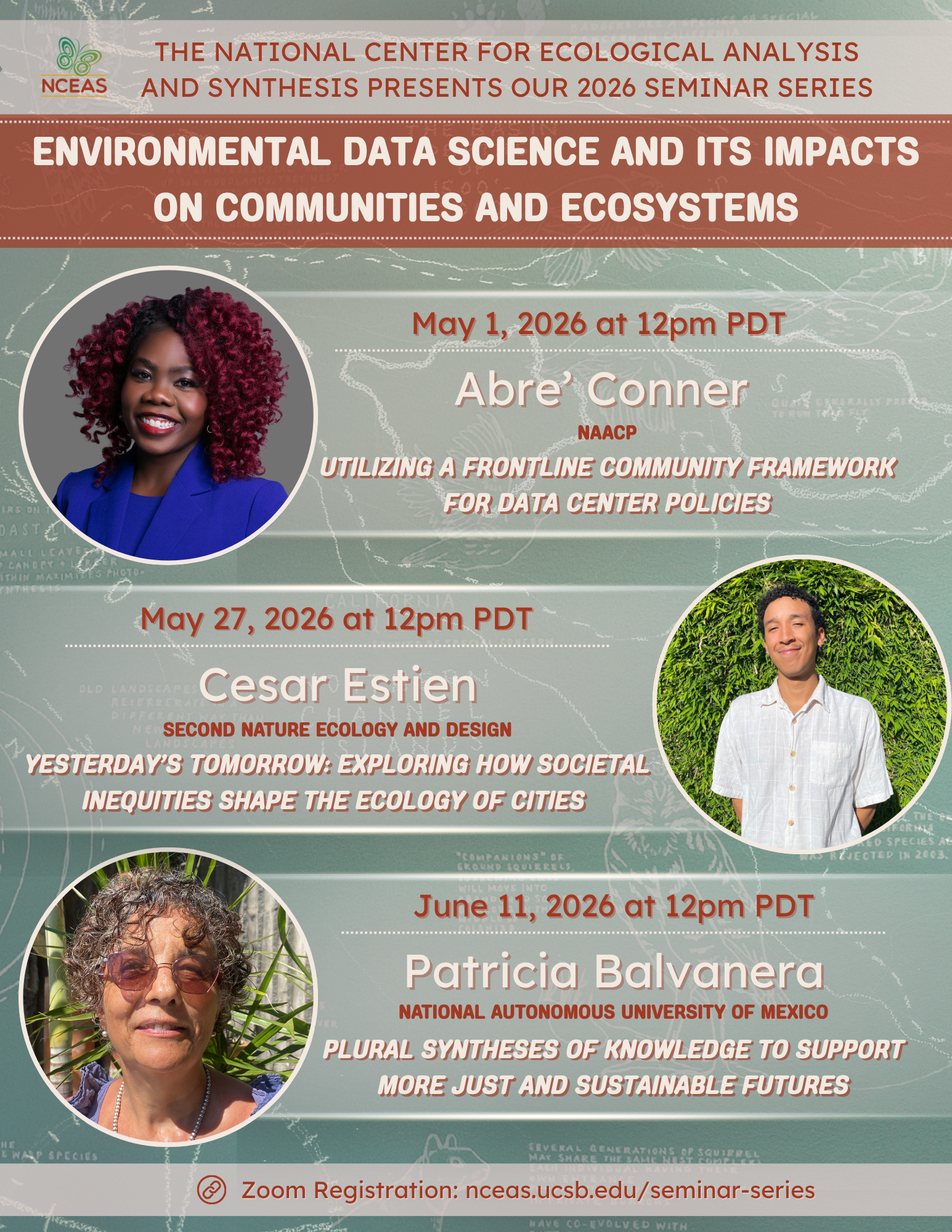
Learn more about each individual event below:
Friday, May 1, 2026, 12:00pm - 1:00 pm PDT
Utilizing a Frontline Community Framework for data center policies
Abre’ Conner, NAACP
Abstract: This presentation explores how having community-led strategies can ensure more equitable and sustainable data center policies. As AI data infrastructure rapidly expands, the communities who first identified the environmental and climate, economic, and social impacts were frontline communities. This is because those communities have a history of feeling the disproportionate effect of pollution, energy burdens, water concerns, and land use pressures. Utilizing an intersectional and cross-sector approach, this talk outlines how centering these communities in policy design can lead to better outcomes than other energy policies of the past.
Attendees will gain an overview of key principles behind the NAACP’s Frontline Framework, including community-led decision-making, strategies, and playbooks for ways to approach data center policies and research moving forward. The presentation will also examine how to properly integrate these principles into data center siting, energy sourcing, water usage, and regulatory processes. The NAACP Center for Environmental and Climate Justice Center’s approach is based on real world examples to illustrate both challenges and emerging best practices.
Links: https://naacp.org/campaigns/stop-dirty-data-centers
Socials: @abre_conner @ naacp on Instagram and Abre’ Conner on LinkedIn
Wednesday, May 27, 2026, 12:00pm - 1:00 pm PDT
Yesterday’s tomorrow: Exploring how societal inequities shape the ecology of cities
Dr. Cesar Estien, Second Nature Ecology + Design
Abstract: Urban areas are expanding to accommodate the growing human population, with up to 1.5 million km² of additional impervious surfaces projected to be added to the Earth's surface by 2050. As impervious surfaces increase globally, the human-wildlife interface will shrink, subjecting wildlife to the myriad social-ecological pressures of cities and underscoring the need to understand the drivers of biodiversity and wildlife ecology for effective management and conservation initiatives. Moreover, as we aim to protect and bolster biodiversity amidst a global decline in species, investigating how biodiversity data coverage varies across landscapes will be critical for equitable conservation. This presentation will highlight the interconnected futures of humans and wildlife by exploring how legacies of injustice and societal inequity shape urban ecosystem health, biodiversity data, and wildlife ecology.
Links: cesaroestien.com
Thursday, June 11, 2026, 12:00pm - 1:00 pm PDT (Rescheduled: August 14th)
Plural syntheses of knowledge to support more just and sustainable futures
Patricia Balvanera, National Autonomous University of Mexico
Abstract: Science-policy platforms, such as The Intergovernmental Platform on Biodiversity and Ecosystem Services (IPBES), serve a pivotal role in connecting scientific endeavor with the design of global and national policies. In 2014 IPBES identified the need to recognize and integrate the diverse values of nature into decision-making processes. From 2018 to 2022 I co-chaired the IPBES Values Assessment, in collaboration with close to 100 people from 50 countries, to identify what values underpin the current environmental crises and how we can navigate towards more just and sustainable futures. In this talk I will share some of the methodological challenges faced during the undertaking of the assessment. In particular I will reflect on the 50 different research protocols used to review more than 50,000 pieces of evidence. I will discuss what were the strengths and limitations in the face of integrating diverse knowledge, in consideration of geographical biases and those among types of knowledge. In closing, I discuss how syntheses effort best informs regional and global policy design when they mindfully respect and elevate all voices. This approach is crucial to foster the transformative changes needed toward a more sustainable future.
Links: ResearchGate Profile
Socials: Patricia Balvanera on LinkedIn
All talks will be recorded and posted to the NCEAS YouTube Channel, where all our seminar talks from past series are available.
For questions, please direct questions to the NCEAS DEIJ Committee at deij@nceas.ucsb.edu